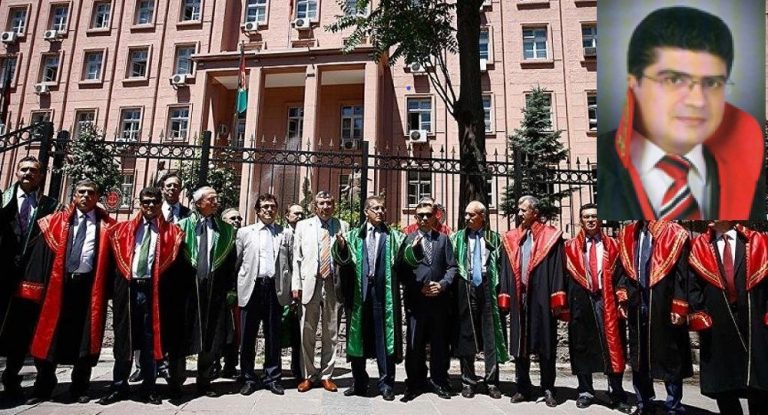
Expelled top judge Erdal Tercan is severely infected with Covid-19 in prison and not released although he is still under treatment at a hospital

Erdal Tercan, expelled Constitutional Court member, was arrested in July 2016. He has been in prison so far. He is infected with Covid-19 in prison and virus spreads into his lung.

Although he is seriously ill and has been at hospital he is not released, his defense lawyer Oktay Erdoğan shared:

Mr. Tercan was sentenced to 10 years and 7 months in prison on 4 April 2019 over the pretext of terrorism charges.

His wife, lawyer Süheyla Tercan died on 10 March 2020 and Criminal Chamber of Court of Appeal has not even allowed him to attend his wife’s funeral.

Sources:

ICJ condemns dismissal of 8 judges and 3 prosecutors by Turkey Council of Judges and Prosecutors as fundamentally unfair, in breach of humanrights, fairtrial and RuleofLaw

The ICJ condemned the dismissal of eight judges and three prosecutors by Turkey’s Council of Judges and Prosecutors (CJP) on 14 October 2020, for alleged membership of or connections with the Gülenist movement as a violation their right to a fair trial.

The ICJ calls on the CJP to revoke its order. In case any further is to be taken, the cases should be re-examined under the ordinary dismissal procedures.  The ICJ also urges the Turkish Government and Parliament to modify the constitutional rules on the CJP to ensure its full independence.

“This decision not  only affects the rights of the judges and prosecutors at stake, but also the Turkish population as whole, which damages the functioning of a fair and independent justice system bound by the rule of law”, said Massimo Frigo, Senior Legal Adviser with the ICJ Europe and Central Asia Programme.

The decision by the Council of Judges and Prosecutors (CJP) is particularly problematic because it was not accompanied by any reasoning on the individual situation of each judge and prosecutor.

International law provides that judges may be dismissed only through a fair hearing before an independent authority. The lack of individual reasoning in dismissal decisions strikes at the heart of the right to a fair hearing.

As the ICJ demonstrated in the 2018 report Justice Suspended, within the current constitutional framework, the Council of Judges and Prosecutors (CJP) is itself  not provided with the guarantees necessary to ensure its institutional independence.

Despite the state of emergency having been lifted since July 2018, extraordinary powers given to the Council of Judges and Prosecutors to dismiss judges and prosecutors during the State of Emergency still apply, having been extended for three  years by Law no. 7145.

“It is unacceptable in a State governed by the rule of law that judges and prosecutors – whatever charges may be against them – be dismissed without a fair procedure, in disregard of international law.” Said Massimo Frigo.

Background

On 14 October the Council of Judges and Prosecutors made use of special powers to dismiss judges and prosecutors without complying with the ordinary procedure, invoking extraordinary powers enacted by Law No 7145 of 31.07.2018. The decision was issued in the Official Gazette on 30 October 2020. This legislation inserted into ordinary law several powers that had previously applied under the state of emergency legislation. More than 30 judges have so far been dismissed under this procedure since the end of the state of emergency.

One of the amendments made by Law No 7145 of 31.07.2018 was to the Decree Law No 375 dated 1989. A Temporary Article (Article 35) was added to the Decree. On the basis of this article, the General Assembly of the Constitutional Court, the Presidency Councils of Court of Appeal, the Council of State, the General Assembly of the Council of Judges and Prosecutors, a Commission set up by the Ministry of National Security, and the Presidency of the Court of Audit, were each authorized to take dismissal decisions for public officials/judges and prosecutors under their mandate for three years from the date of the endorsement of the law No 7145

The decision to dismiss the nine judges and two prosecutors was made on 14 October 2020 and published in the Official Gazette on 20 October 2020. After recalling Law no 7145 that enables the dismissal of judges and prosecutors by the Board, the decision states that all defendants have asked to submit their written defences. The decision also indicates that this is not a criminal conviction. The decision is based on complaints received and refers to investigations on their social environment, criminal investigations and prosecutors conducted by judicial authorities in general on the Gülenist organisation/FETÖ, minutes of hearings, contents of the communication app Bylock, statements by witnesses and suspects. However, the decision does not include any reasoning relating to the individual situation of each judge or prosecutor.

International law and standards provide that disciplinary proceedings should be conducted by an independent authority or a court with all the guarantees of a fair trial and provide the judge with the right to challenge the decision and sanction. Disciplinary sanctions should be proportionate.

The UN Basic Principles on the independence of the judiciary set out international standards for discipline, suspension and removal of judges, including in order to ensure impartiality and independence of courts and tribunals as required by international law, including the International Covenant on Civil and Political Rights and the European Convention on Human Rights. The Basic Principles state that a:

“charge or complaint made against a judge in his/her judicial and professional capacity shall be processed expeditiously and fairly under an appropriate procedure. The judge shall have the right to a fair hearing. The examination of the matter at its initial stage shall be kept confidential, unless otherwise requested by the judge”

The Consultative Council of European Judges (CCJE) adds that “a Head of State, Minister of Justice or any other representative of political authorities cannot take part in the disciplinary body.”

Source:
www.icj.org

ENDLESS PURGE: 11 more judges and prosecutors are dismissed in Turkey

0

More than four years after the 2016’s botched coup in Turkey, the Council of Judges and Prosecutors which is under total control of the Erdogan Government has dismissed 11 more judges and prosecutors over the pretext of terrorism allegations.

Since July 2016, 4500 judges and prosecutors are dismissed and most of them were arrested.

Source:

www.sozcu.com.tr

Former judge Hüsamettin Uğur, who was arrested and tortured in prison, now gets disciplinary punishment

Hüsamettin Uğur, former judge at Court of Cassation (Supreme Court of Appeal), who was arrested and tortured in prison, was imposed disciplinary punishment (communication ban with his family) by prison administration. His daughter @nalandilora tweeted on 15 October 2020 that her father got disciplinary punishment because of their telephone conversations. (1)

Furthermore on 5 November 2020 he got new disciplinary punishment (confinement in small/awful cell) over the pretext of defaming prison guards. He was already under solitary confinement for 4 years but new one is terrible.

Hüsamettin Uğur was beaten by four guards in a prison room without cameras, on 17. February 2020. However, prosecution office ruled ‘nolle prosequi’ regarding charges of torture in favor of prison guards although he has medical report. (2)

“The Platform for an Independent Judiciary in Turkey” reacted against torture claims as follows (3): “The most recent and worrying case is that of Judge HÜSAMETTIN UĞUR, a former member of Turkey’s Supreme Court of Appeals, who has been isolated in a one-person cell in a Kırıkkale prison since July 2016. According to his daughter and the TR724 news website, Judge Uğur was beaten by four guards in a room without cameras on February 17. Judge Uğur’s daughter tweeted: “When they left him alone after he collapsed on the ground, they said, ‘Only your dead body will leave here’.”, further revealing that the guards subsequently forged a medical report suggesting that it was Hüsamettin Uğur who attacked them so that he cannot file a criminal complaint.”

Hüsamettin Uğur was sentenced to 10 years 6 months in prison on 28. February 2019 and he has been in solitary confinement cell in prison since July 2016. (4,5)

Sources:

1-https://kronos34.news/tr

2-www.turkishminute.com

3-www.medelnet.eu

4-www.freejudges.eu

5- www.haberler.com

The Platform for an Independent Judiciary in Turkey, of which MEDEL is a member, has released a statement, marking another anniversary of the attempted coup d’Etat in Turkey.

The Platform for an Independent Judiciary in Turkey, of which MEDEL is a member, has released a statement, marking another anniversary of the attempted coup d’Etat in Turkey.

A similar letter has been also sent to the Secretary-General of the Council of Europe.

TURKEY – FOUR YEARS OF DISMANTLEMENT OF RULE OF LAW

Four years ago, on July 15th 2016, a failed coup d’état in Turkey set in motion an unprecedented and orchestrated campaign to destroy the Rule of Law and the independence of the Judiciary.
The huge impact and subsequent national trauma caused by the events on July 15th 2016 should be acknowledged. But those responsible should be made accountable through an open, fair and impartial judicial process, conforming with international standards.

In the early hours following the coup, thousands of Judges and Prosecutors have been arrested under dubious charges of links with terrorist organizations, based on a list of names that had evident signs of having been pre-prepared long before the coup took place.

Judges and prosecutors have been held in common prisons, in overcrowded cells or in solitary confinement, in conditions that violate the most basic human rights. They have been permanently dismissed from their positions by their Council without a fair and contradictory process, their assets have been frozen, they are forbidden to leave the country and the association that independently represented them (YARSAV) has been administratively disbanded.

The Turkish High Judicial Council (HSYK) has not only failed to serve as guarantor of the independence of the Judiciary in face of the other powers of the State, but became a mere extension of the Executive Power, promoting or allowing all the abuses being made, as its suspension by the December 8th, 2016 decision of the European Network of the Councils for the Judiciary (ENCJ) clearly showed.

Four years later and the situation has gone even worse.

MURAT ARSLAN, the President of YARSAV – winner of the 2017 Vaclav Havel Human Rights Prize, awarded by the Parliamentary Assembly of the Council of Europe – was convicted to 10 years in prison after a trial that has not met any of the requirements of due process of law.

Judges, prosecutors and lawyers continue to face unfair persecution simply because they stand for the values of Rule of Law. Those who are in jail face precarious conditions and ill-treatment.

MEHMET TOSUN, former rapporteur judge at the Council of State of Turkey, passed away at 29 years of age on March 6th, 2017. Like many other judges, he was dismissed and detained under severe conditions after the attempted coup with no evidence and solid reason. He suffered from an autoimmune illness. According to his lawyer, Hüseyin Aygin, Mehmet Tosun was mistreated in jail and his state of health deteriorated. Although he spent his last months at hospital due to his heavy health problems, he was deprived of even his assets and personal savings, access to his personal bank accounts which were crucial for his medical treatment which obviously costed enormous amount of money for a dismissed person with no social security.

SULTANI TEMEL has been arrested (followed by pre-trial detention) since 16 January 2017 (with exception for the period of 5 October 2017 to 6 June 2018), together, until recently, with her five-year-old daughter. Whereas judge Temel suffers from a major depression without having access to adequate medical treatment, her daughter suffers equally, being denied to see her mother since February 2020.

The most recent and worrying case is that of Judge HÜSAMETTIN UĞUR, a former member of Turkey’s Supreme Court of Appeals, who has been isolated in a one-person cell in a Kırıkkale prison since July 2016. According to his daughter and the TR724 news website, Judge Uğur was beaten by four guards in a room without cameras on February 17. Judge Uğur’s daughter tweeted: “When they left him alone after he collapsed on the ground, they said, ‘Only your dead body will leave here’.”, further revealing that the guards subsequently forged a medical report suggesting that it was Hüsamettin Uğur who attacked them so that he cannot file a criminal complaint.

Democracy and human rights are questioned in several Council of Europe´s member states. The developments in Turkey have to be seen as destroying both, but especially the erasing of an independent judiciary is a key element to make these negative developments possible.

On this day and date, the Platform for the independence of the judiciary in Turkey reaffirms its solidarity and support to all those judges, prosecutors and lawyers in Turkey that are truly independent and are engaged in the struggle for a free judiciary and the return of the rule of law in Turkey.

The Platform for an Independent Judiciary in Turkey gathers four European Associations of Judges and Prosecutors:

Association of European Administrative Judges (AEAJ),

European Association of Judges (EAJ),

Judges for Judges and

Magistrats Européens pour la Démocratie et les Libertés (MEDEL)

July 15th 2020

Former judge Yavuz Aydın wrote an article for Ahval English on recent amnesty bill in Turkey

0

Former judge Yavuz Aydın wrote an article for Ahval English on recent amnesty bill in Turkey. Aydın highlights the ineffectiveness of the application of Main Opposition Party (CHP) before the Constitutional Court and addresses other problematic regulations in the bill.

Erdogan’s presidency enforced an amnesty bill recently but it excluded the political prisoners. The statue also gives a full authority to the Intelligence Units to take the inmates out of prison up to 14 days for interrogation. What’s worse is, Main Opposition Party CHP’s application against the new law before Constitutional Court which based on only prosecudal grounds will not help non-violent political prisoners.

Aydın tweeted also on bill that, for the fading hopes of dissidents in jail, CHP’s recent application against amnesty bill before the Constitutional Court has the risk to be the final nail in the coffin. Does the CHP really have a strategy to restore Rule of Law in Flag of Turkey? (1)

Aydın argued, by focusing on “deformity” without considering the legal consequence under Art 36/3 of tle Law on Constitutional Court, CHP made the least strategical move which might fade the hopes to of non-violent political prisoners. (2)

Here is the full article published by Ahval English:

“The Turkish parliament last week enacted the bill to release some 90,000 of the country’s 300,000 prison inmates on early parole and probation, ignoring warnings from dozens of international NGOs, the European Parliament and the Council of Europe’s Human Rights High Commissioner, that it should not exclude political prisoners.

The bill is bad news for dissidents who have been jailed under Turkey’s vaguely defined anti-terror laws that can see a person deemed a terror propagandist for criticising the government on social media.

Moreover, last-minute additions to the bill could see some of the government’s rendition and torture of detainees become backed by legislation, and the opposition’s appeal against the new laws could leave dissidents behind bars even if it is successful.

This means that 50,000 people jailed for terror offences, most of whom have nothing to do with terror or violence, have been left behind bars, while thousands convicted of organised crime, theft, fraud, corruption, violence against women, and other serious crimes walked free.

Not surprisingly, by manipulating terror accusations for political purposes, President Recep Tayyip Erdoğan has exploited the current COVID-19 pandemic to consolidate his own position, with support from his far-right coalition partners, the Nationalist Movement Party (MHP).

Among the late additions to the bill, one article inserted at 3 a.m. on the last day of discussions that raised even further criticism excluded people charged with offences against the National Intelligence Organisation (MIT) from the release programme.

So, six journalists who were arrested this year after reporting on a MIT officer killed in Libya will take their places among the thousands of dissident lawyers, judges, politicians and the 90 other journalists forced to remain in the country’s crowded prisons during the pandemic.

This was not the only radical provision inserted into the bill on the same night. As the lawyer and human rights activist Orhan Kemal Cengiz has analysed, this law now authorises MIT to remove people convicted on terror charges from prison for interrogations for up to 14 days.

It is no secret that unregistered detentions and torture in unofficial detention centres have been taking place regularly in Turkey since the 2016 coup attempt. Experts from the United Nations and international media institutions have openly criticised Erdoğan’s government for similar practices.

But thanks to this law, these practices would be effectively legalised, since the law includes no detail on the conditions or whereabouts of where interrogations take place, nor any standards to safeguard the fundamental rights of detainees under interrogation.

Another regular introduced with Article 36 of the new law will make it more difficult for terror convicts to be granted parole. This article foresees the introduction of new boards, comprising a prosecutor and two other government officials, that will have the sole authority to decide on conditional release of terror convicts after they have served at least three quarters of their sentences behind bars.

To be eligible for parole, terror convicts will now be forced to sign a petition in which they express remorse for their crimes. This would essentially force many people convicted of crimes they did not commit to confess their guilt if they wish to be released – a practice that perfectly exemplifies the government’s legalisation of illegitimacy.

What is more interesting is that these amendments, which are in breach of European Convention on Human Rights and other international standards, have been presented as “judicial reform packages”.

The previous reform package came in September 2019. Amnesty International’s report rightly criticised those amendments as “a lost opportunity to address deep flaws in the Turkish justice system”.

Indeed, instead of addressing the main problems plaguing Turkey’s judicial system, that package included provisions that aimed to retain the arbitrariness of many practices. One of the most significant setbacks in the package was regarding the duration of pre-trial detention for those accused of terror crimes. Saying nothing about shortening the total pre-trial detention period of seven years, the so-called reform legalised keeping these people in jail for two years without any indictment.

Among the amendments presented in the 2019 package as a sign of progress was one that allowed people sentenced to less than four years in prison to appeal before the high court for release. But while this led to the immediate release of three journalists, nearly 100 more remained behind bars.

Moreover, this regulation was criticised by Kerem Altıparmak, the head of the Human Rights Centre of Ankara Bar, who said it aimed to prolong the period it takes for people of Turkey to reach the European Court of Human Rights to almost ten years since applicants must exhaust all domestic remedies before applying. The chance to appeal to a high court adds another lengthy step to that process.

This is to say that the situation for Turkey’s judicial system was already grave, and the opposition faced an uphill struggle in attempting to stop last week’s amendments. Nevertheless, the legal and constitutional fight is by no means over.

Having lost the battle in parliament after a week’s struggle, the main opposition Republican People’s Party (CHP) has taken this law before the country’s highest legal body, the Constitutional Court.

As stated by CHP Deputy Engin Altay on 22 April, the annulment application is built upon Article 65 of Turkish Penal Code and Article 87 of the constitution, which suggests that the release of some 90,000 inmates is in fact, a “special amnesty” rather than an amendment on execution of sentences.

Unfortunately, building the annulment application on this argument instead of the “equality principle” under Article 10 of the constitution carries an undeniable risk which the CHP deputies in charge of making the application, being experienced lawyers by profession, you would expect to have taken into account.

Since the CHP’s argument is underpinned by the fact that an amnesty bill requires support from 360 deputies, which the ruling coalition does not have, this application may result in a total annulment of the amendment. But the risk is that, if accepted by the Constitutional Court, this would be the only tangible result, effectively consolidating the government’s policy of keeping all dissidents in jail.

This would mean there will be no legal basis for release to be extended for those left behind bars, while those already released would remain free thanks to the principle on non-retroactivity of the Constitutional Court’s decisions.

And, since the Constitutional Court is bound to adjudicate on the type of application the CHP has made before ruling on any applications made on the equality principle, if the application is successful there will be no law for the court to consider in a subsequent appeal. The last hope of the political prisoners to be released through the Constitutional Court’s decision would be destroyed.

This is the scenario the Constitutional Court could well favour, since it would be unlikely to incur the government’s wrath even though it rejected the ruling coalition’s amendment.

Furthermore, the highest court of Turkey would have the chance to partly save its reputation and image of independence by taking the chance to add a new illusory decision in its track record. At the end of the day, everybody would win except the persecuted dissidents in jail. (3)”

Sources:
1) https://twitter.com/yavuzaydin8
2) https://twitter.com/yavuzaydin8
3) https://ahvalnews.com
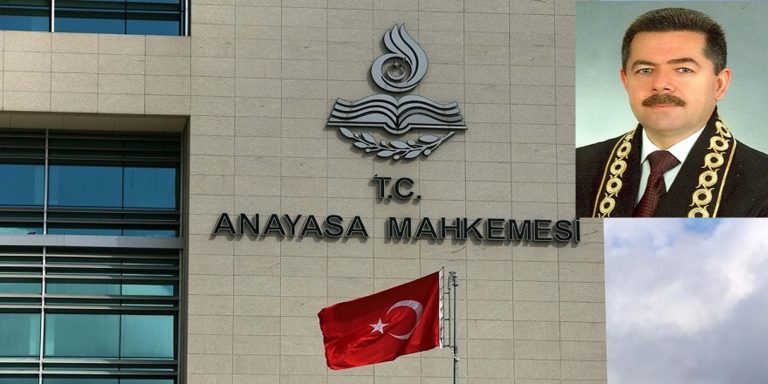
Former member of the Court of Cassation Mehmet Sait Demiröz was sent back to prison following a lung-operation amid the high risk of COVID-19. He has also been suffering from diabet and serious heart problems.

Former member of the Court of Cassation Mehmet Sait Demiröz was sent back to prison following a lung-operation amid the high risk of COVID-19. He has also been suffering from diabet and serious heart problems.

56-year-old supreme Court judge Mr. Demiröz had been kept in solitary confinement for 42 months in Sincan and Ereğli(Konya) prisons. After surgery he was put in a prison ward for only ten inmates. He is not taken to his routine controls due to COVID-19 pandemic. His immune system is so weak. As the pandemic spreads, his family is deeply worried about his life.

Demiröz was arrested on 21 July 2016 and sentenced to 13 years 6 months in prison over the pretext of terrorism charges on 19 March 2019. Although the Grand Chamber reversed the decision of relevant chamber,he has been still under detention as the trial is pending.

Sources:
1-https://twitter.com/kmelmas
2-https://twitter.com/freejudgeseu
3-https://www.boldmedya.com

Former prosecutor Mehmet Yurt was sentenced to 6 years 3 months in prison on 10 January 2020

0

Former prosecutor Mehmet Yurt was sentenced to 6 years 3 months in prison over the pretext of terrorism charges on 10 January 2020.

Source:
https://www.memurlar.net

Former prosecutor Mustafa Kemal Tunç was sentenced to 6 years 3 months in prison on 26 December 2019

0

Former prosecutor Mustafa Kemal Tunç was sentenced to 6 years 3 months in prison over the pretext of terrorism charges on 26 December 2019.

Source:
https://www.memurlar.net

Former prosecutor Muammer Taha Ekim was sentenced to 7 years 6 months in prison on 23 December 2019

0

Former prosecutor Muammer Taha Ekim was sentenced to 7 years 6 months in prison over the pretext of terrorism charges on 23 December 2019.

Source:
https://www.memurlar.net